
Complete HVAC Modernization at Polk County High School
Polk County Schools is a small, high-performing school district in Western North Carolina. The district’s sole high school was built in the early 1990’s with a two-pipe HVAC system that struggled to maintain proper humidity and temperature control throughout the year. With the building’s water-cooled chiller at its end of life and obsolete building controls, it was time for a comprehensive upgrade of the building’s systems. Polk County Schools decided to use the design-build method to select a partner who would help identify the best solution, establish a fixed lump-sum price with no change orders, and own full responsibility for the design and construction of the project.
I can say wholeheartedly that I have never worked with a better company. We have been glad to work with Brady on this project and would enthusiastically recommend them to anyone facing a major HVAC project within their schools.

Brady started with a system selection charrette, where they presented multiple options and discussed the pros and cons of each with the district. Based on factors such as first cost, operating cost, temperature and humidity control, ease of maintenance, and ease of construction, the district selected air handling units (AHU) with variable air volume (VAV) boxes paired with two air-cooled chillers. The project also included new controls, lighting upgrades, and replacement ceilings.
The project also qualified for a rebate of $155,176, which was used to upgrade the chillers to the ultra-quiet and high-efficiency Trane ACRB model to ensure that the new units would not disrupt any outdoor classes held nearby.

The largest challenge of this project was performing construction in an occupied school throughout the school year. Construction began in the summer of 2021 with trunk lines and pipework throughout the hallways and in the common areas. Then, as the AHUs arrived, work was phased throughout the school in batches of four to five classrooms. These sections of each wing were cordoned off from students and staff to ensure their safety, and the majority of the work occurred in the evenings and nights to limit disruptions to the learning environment. Finally, all remaining areas of the building were completed during the summer of 2022 before the next school year began.
Completing invasive construction during the school year without affecting the learning environment required significant coordination and consistent communication.
After commissioning was completed in late 2022, the project transitioned into the ongoing monitoring of the building’s performance to ensure that it meets the “performance standard” written into the contract. This performance standard commits to the District that the new system will provide proper temperature and humidity levels. Brady continues to provide remote monitoring and reporting to “tune up” the building operations as it transitions into ongoing operations.
Brady worked above and beyond to accommodate our school schedule and stay as hidden away from day-to-day operations as possible. They were attentive to detail and highly responsive to any concern I had.
Ready to bring your HVAC renovation vision to life?
Contact Brady today and discover how our design-build expertise can turn your goals into reality.
Related Blogs
Brady Dedicates Second Habitat Home in Greensboro
On Saturday, May 14th, Brady Associates and key community leaders gathered to dedicate the second Habitat for Humanity House sponsored by late founder and chairman Don Brady and his wife, Mary Gay.
Contingency Planning: Essential for Business Continuity
Rare but impactful events such as power outages, natural disasters, or mechanical failures can wreak havoc on your facility and business. Facing such an emergency without a contingency plan can result in decreased production or service, lost customers and revenue, and loss of confidence by customers, investors, and other stakeholders. In fact, the stakes can be so high that it’s not uncommon for insurance companies to require a formal contingency plan to qualify for business continuity coverage.
The Evolution of Changeover Systems
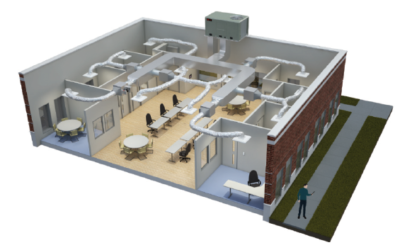
Many light commercial buildings have traditionally used several single-zone, packaged rooftop units with thermostats—often because better systems were thought to be too complicated and/or too expensive to install. If “zoning” was desired in these buildings, a changeover bypass system was traditionally used; this system allowed a single rooftop unit to provide independent temperature control to several zones. However, it used a constant-speed supply fan and a centralized bypass damper, resulting in higher energy use and sound levels than other system alternatives.